
Texas City Directory Coverage
Texas has no continuous directory run for every town. The Texas State Library and Archives Commission (TSLAC) is a statewide finding aid, but its holdings remain town-specific. Begin with the city or postal community and county used at the time; one title may cover suburbs, rural routes, or nearby towns. The table separates directories from records that can supplement a household search.
| Texas collection | Coverage | Where held | Access route |
|---|---|---|---|
| TSLAC directory holdings | Print and microform; exact years vary by city or town | TSLAC Archives and Information Services Reading Room, Austin | On-site use; staff do not search or send scans by phone or email |
| Portal to Texas History | Digitized Texas city and county titles; item dates vary | UNT Portal to Texas History | Free browse and search; inspect each item's page images and metadata |
| Dolph Briscoe Center Texas Directories | Most Texas cities and towns, roughly late 19th century to present, with gaps | UT Austin's Briscoe Center | Catalog and reading-room rules; confirm item-level access |
| U.S. City Directories 1822-1995 | Selected cities, counties, and years, not every Texas place | TSLAC and local or academic libraries | Ancestry Library Edition and HeritageQuest access depends on library license and item |
| NARA circa-1930 directories | Separate Texas city and year sets | National Archives facilities and microfilm | Check the named city and year before planning access |
| TSLAC county tax rolls | Early years through the late 1970s for many counties; local spans vary | TSLAC Genealogy Collection and microfilm | Ownership context; use with deeds and census, not as a directory |
| Texas county-record microfilm | Many counties and record series, with gaps | 23 Regional Historical Resource Depository locations, TSLAC, and partner collections | Check the county and series guide; not every record was filmed |
TSLAC's guide is a finding aid, not a promise of a complete run for each Texas town. Print and microform directories are for on-site use in Austin; staff do not search names or send scans by phone or email. Check the catalog for town, year, and format. If travel is not practical, try a digital item, local library, or researcher, each with its own access terms.
For shelf holdings and search limits, review TSLAC's directory guide before planning a visit.
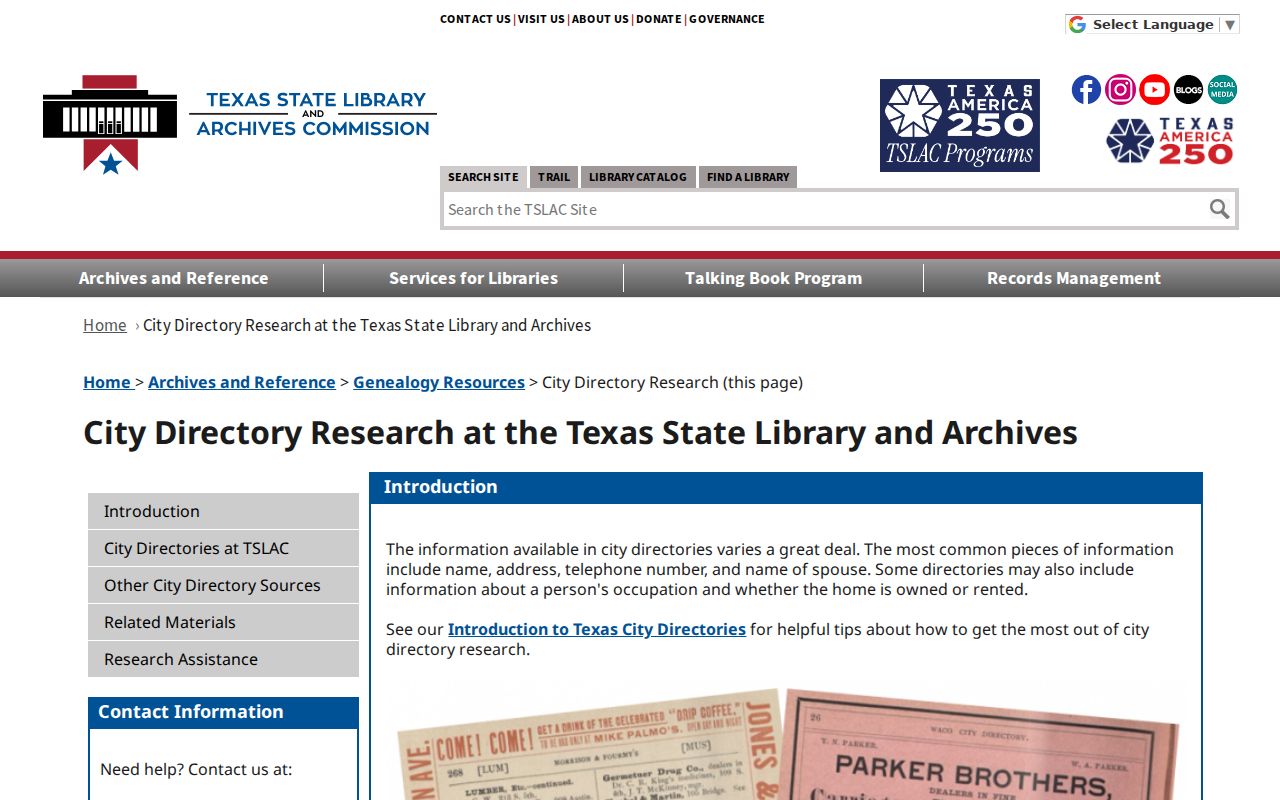
The guide also points to online directories and library-held databases, so a shelf visit is only one part of the statewide search.
Texas City Directory Entries
A printed entry is a dated clue, not a full account of everyone at an address. TSLAC lists common fields as name, address, telephone, and spouse; some volumes add occupation or a residence-status symbol. Publishers use different abbreviations, and one household may appear under more than one name. Read the key before treating a short mark as fact.
| Sample entry field | What to record from the page |
|---|---|
| Name line | Printed surname, given name or initial, honorific, and spelling as shown |
| Household marker | Spouse in parentheses, separate spouse listing, or a widow notation such as "wid" |
| Street line | House number, street spelling, direction, unit, and any residence notation |
| Phone line | Exchange and number when included in that year's volume |
| Work or business clue | Printed occupation or firm, used only to distinguish same-name entries |
| Cross-reference | "See" entry, street index, business listing, or reverse section reference |
| Volume key | Publisher's abbreviation legend and any residence-status symbol, if used |
Capture the printed line, page, and edition. A short entry may point to a second listing, and a business address may sit near residential pages. Texas names can vary by initials, accents, maiden names, and double-surname order, so preserve the source spelling before making a normalized note.
- City directory
- A yearly or periodic book that may list residents, addresses, phones, businesses, and selected household details for a named place.
- Criss-cross section
- An address-ordered part of a directory. It lets a reader start with a street and number, then read the listed occupant or business.
- Householder index
- The name-ordered section used to find a person's entry before checking the address section.
- Abbreviation key
- The publisher's legend for marks such as "wid" or residence status. Its meaning may differ by book or year.
Note: Directory fields differ by publisher and year, so the sample inventory describes common features rather than a fixed Texas form.
Tracing Texas Households Between Census Years
For Texas family history, follow a name and address through nearby editions, then compare those entries with the federal census. A census records a household on its enumeration date; a directory may place someone at a street address in a nearby year. The public decennial run reaches 1950 under the 72-year release rule.
- Set the likely city, postal community, and county from a known address or family record.
- Search surnames, initials, maiden or spouse names, accent variants, and likely spelling changes.
- Copy the exact name, address, spouse marker, phone if present, and abbreviation key from the image.
- Compare a late-1930s directory with the 1940 census, or a late-1940s edition with 1950, if the town's volumes exist.
- Check a dated deed, voter record, church entry, court file, or obituary for an independent match.
An absent name may reflect a move, a different spelling, a missing volume, or a missed entry. The census confirms one point, not every intervening year. Keep dates and evidence separate when names match.
When an older listing needs a present-day identity check, the Texas resident lookup page describes how to compare a name with current official records.
Texas City Directories Online
Online access in Texas depends on which title was digitized and how its record is licensed. The Portal to Texas History City Directories Collection offers free search and browsing for digitized items. Its dates and page scans belong to each item, so a search result for one town does not show that the next town or year is present.
A free scan helps with the item it contains, but not a title or year that is absent.
The Dolph Briscoe Center holds directories for most Texas cities and towns from roughly the late 19th century to the present, with gaps. TSLAC also points to Ancestry U.S. City Directories 1822-1995 and HeritageQuest. Access at TSLAC is on-site; other library access depends on the license and item, so a login does not guarantee every town, year, or image.
| Route | What is available | Access check |
|---|---|---|
| Portal to Texas History | Free digitized items | Check town and date metadata |
| Briscoe Center collection | Most towns, late 19th century to present, with gaps | Catalog and item terms vary |
| Library databases | Selected titles and years | Access depends on license and item |
NARA's Circa-1930 Texas Runs
The National Archives and Records Administration (NARA) lists separate city and year sets around 1930. Texas entries include Austin, Dallas, El Paso, Fort Worth, Houston, San Antonio, Waco, and other places. These discrete holdings do not show that each town has a 1930 volume or nearby years.
Check NARA's item-level city and year before planning access. The Texas research record names cities but does not reproduce every year in the table. Combined titles may cover nearby places, such as Beaumont, Port Neches, and Nederland.
If the needed town is absent, compare TSLAC, the Portal, Briscoe catalog, and local libraries for another year or format.
Note: "Circa 1930" describes the collection group, not a continuous 1930 directory for every Texas city.
Texas Reverse Directories by Street
A reverse or criss-cross section changes the direction of the search. Instead of finding a person's name first, locate a house number and street, then read the person or business printed beside it. Later Texas volumes may include this address-ordered section, but its presence and years depend on the publisher and town. Save the street spelling exactly as printed, including direction and abbreviations.
If the reverse section is missing, a standard directory's street section, an older phone book, or a local tax roll may offer a partial substitute. A tax roll shows property ownership; a directory may list an occupant. Neither proves every household member lived there.
Use the volume contents to find the right section and compare nearby years. Follow a name through the personal index or start with the street section for a house history. Check whether a listing is for a person, household, or business.
Texas City Directory Gaps
Texas directory runs vary by place, publisher, format, and year. A missing scan may mean that a volume was never issued, is held only in print or microform, or has not been digitized. A change in title or publisher can also interrupt a catalog search. Do not read an empty year as proof that a household moved or that a person died.
A title may cover postal communities, suburbs, rural routes, or nearby counties under a larger city's name. Census places and city limits differ, and an annexed neighborhood may retain an older town label. Check the book's coverage notes before comparing it with a modern Texas address.
ZIP Codes began in 1963. Older books use street addresses, rural routes, and postal-city labels, so use a plat, deed, or street ordinance when the modern number or name no longer matches.
Texas's 23 Microfilm Repositories
The Regional Historical Resource Depositories program placed county record reels across 23 Texas locations. TSLAC and the Genealogical Society of Utah, now FamilySearch, filmed many local books from the 1970s through the early 1990s. Coverage is incomplete: some counties or series were not filmed, and old ink may be faint.
For county records that can support an address or household trail, use TSLAC's county-by-county microfilm guide to identify the series, reel, and repository.
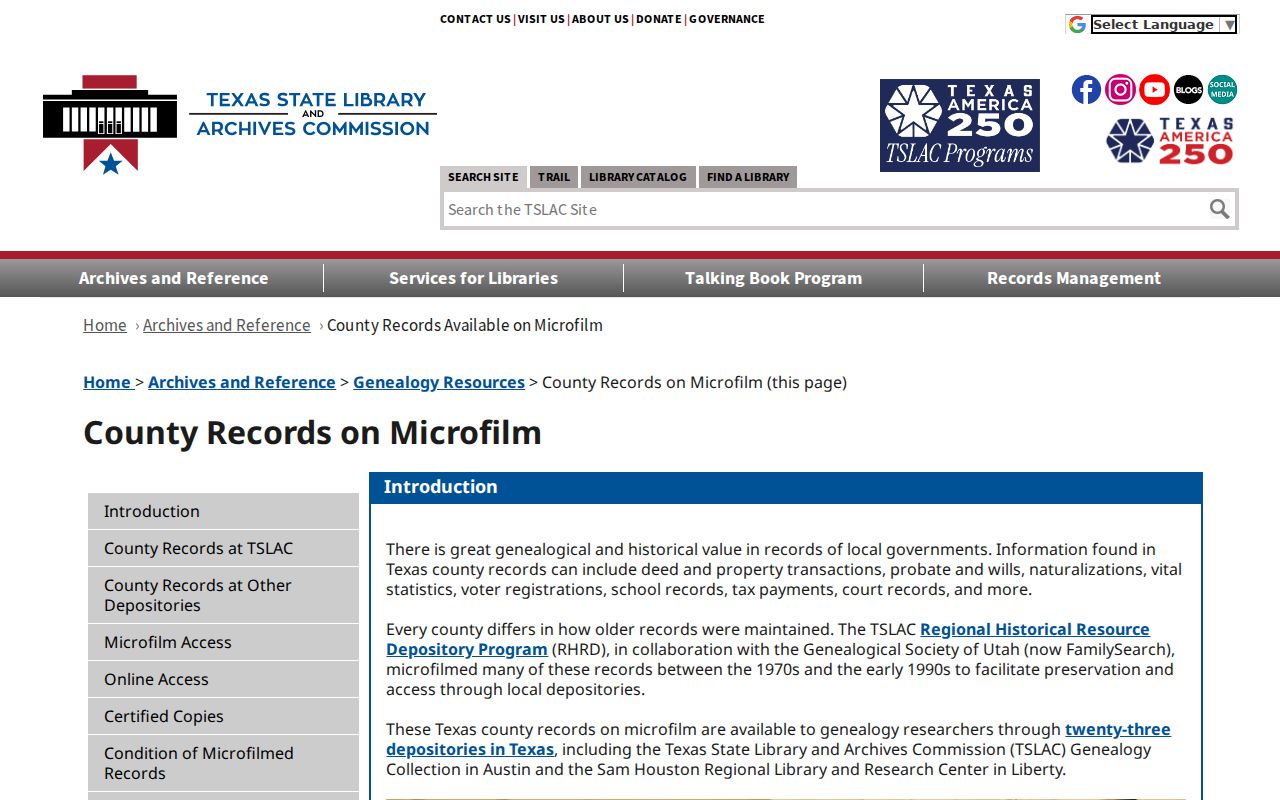
A reel may cover only one record series or part of a county's history, so check the finding aid before treating a gap as a missing record.
TSLAC allows up to five reels for one week in Austin; interlibrary loans are generally 14 days, with a possible extension. Check whether a FamilySearch image is restricted to an affiliate location. TSLAC cannot certify a copy; request legal proof from the county or district custodian.
Note: Microfilm preserves a copy of a record series, but the county clerk remains the source for a certified real-property document.
Cross-Checking Texas Directory Entries
Texas newspapers may hold obituaries, marriage notices, legal filings, business listings, and community news. Cemetery ledgers and church registers can add a burial, family link, or congregation date. Check the date and wording: a newspaper address may be a business, hospital, church, or temporary location.
Yearbooks help when a school or class year is known. University collections may hold campus papers and oral histories; local libraries may have phone books, newsletters, cemetery files, and newspaper microfilm. Ask for the exact title and year span.
TSLAC's 1867-1870 voter-registration ledgers form a separate historical source, not a continuation of those books. An entry may give county, precinct, residence length, nativity or naturalization, and remarks. Compare those details with a directory and census record before deciding that a same-name entry belongs to the same person.