
Starting a Texas Resident Search
Choose a record by the fact you need to confirm. A name can lead to a voter-status check, a public court index, or a professional license. An address points first to a local appraisal district or map. An older household calls for a directory, census, or county archive. Texas has no master list that joins those records, so one source rarely answers every part of a question.
Keep a short search log as you go. Write down the exact name or address, the county, the date searched, and the record number or page that appears. That lets you test a second source without mixing two people who share a name. A Texas residents directory search works best as a path from one dated record to another, with each link checked at its own custodian.
- For a property address, verify the local county and open its appraisal district record.
- Save the parcel ID, legal description, situs address, and separate mailing address.
- Use VoteTexas for an individual's registration status, or ask about a lawful voter-list request.
- Check the county clerk's deed index or the court portal when a document or case is the question.
- For a past household, compare a directory year with census, newspaper, probate, or microfilm records.
An owner, party, voter, license holder, or directory entry gives a dated role, not a full household list. Nonowners, guests, and protected people may not appear. Describe a result by what the record says and when it was made.
Texas Residents Directory Offices
Texas sets many access rules statewide, but local offices hold the records. Each county clerk keeps its own real-property index; each county appraisal district runs its own public property database; county registrars manage voter records; and local court clerks hold case files. There is no statewide Texas recorder, parcel viewer, or county-jail roster. Find the county from the physical parcel, not just from a postal city name.
The Comptroller's county directory routes users to each local appraisal district and tax office. It does not hold the local owner record. Confirm the county from the physical parcel when a mailing city crosses a boundary.
Texas State Library and Archives Commission
Genealogy guides, city-directory holdings, county microfilm, and regional depositories.
Texas DSHS Vital Statistics Unit
Statewide birth, death, marriage, and divorce indexes, verifications, and application routes.
Texas Secretary of State Elections
Voter lookup and statewide voter-list request information; county registrars administer registration.
The Comptroller routing page shown here matches a Texas property question to the local appraisal district. It does not contain the parcel card itself.
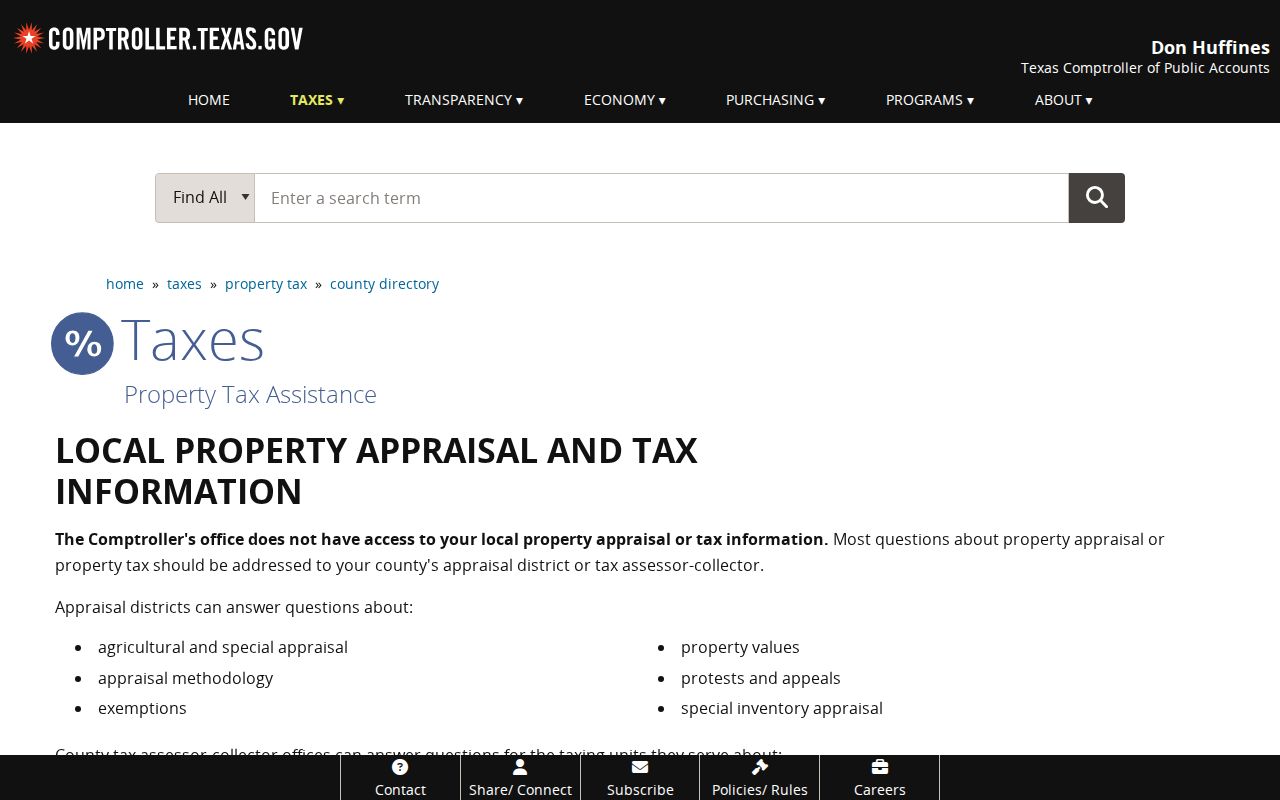
After that first step, use the selected district's own database for address, owner, parcel, and tax fields. The record is local even though the route is statewide.
Texas Resident Property Search Fields
Tax Code §26.17 requires a public county property-tax database that can be searched by owner and property address, unless a lawful restriction applies. A Texas search begins at the local appraisal district, not at the Comptroller. The public database must include a property identification number, market value, taxable value, taxing units, and tax-rate or budget information. A local card may also show the situs, owner, mailing address, legal description, exemptions, sales history, sketch, or year built.
The Comptroller's property-database standard describes the owner and address search duties. Use the local search controls for the actual parcel, and keep the account number as a join key for deed, GIS, and permit records.
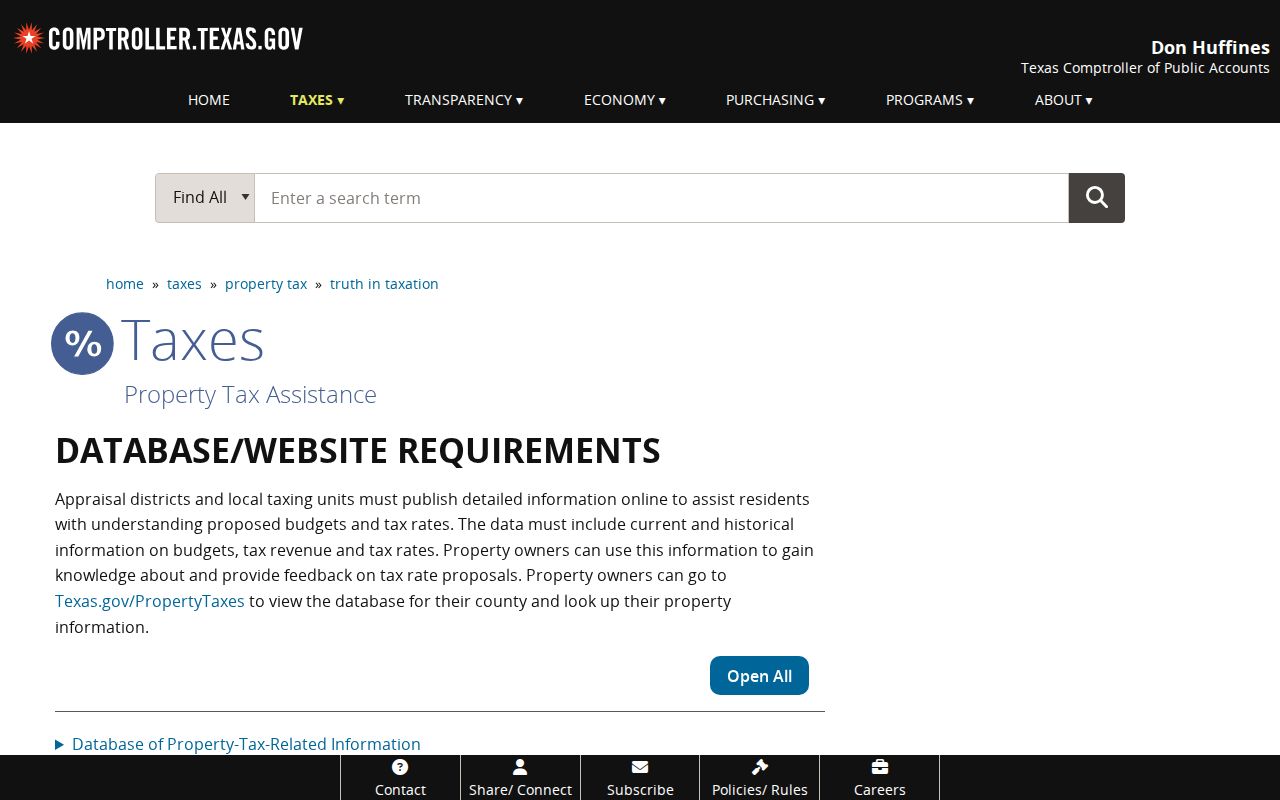
A Texas property result identifies an account and the fields displayed by that district. It is not a count of all people at the parcel.
| Search control | Input or result | What to keep |
|---|---|---|
| Owner name | Name or autocomplete, where offered | Spelling, middle initial, and entity suffix |
| Situs address | House number, street, unit, or address match | Standardized form and county |
| Parcel or account ID | County-specific number | Primary link to GIS and deeds |
| Legal description | Lot, block, survey, or tract | Plat name and any replat reference |
| ZIP or tax year | Local optional filter | Some districts offer these; they are not universal |
Current Texas Residents Directory Sources
Current Texas records point to different relationships with a place. The appraisal roll names an owner of record. VoteTexas is a voter-facing status check. A deed records a transfer or other instrument, while a court index names parties in a case. A license profile ties a person to a regulated credential or public business role. None is a statewide household roster.
| Record source | What a name means | Keeper | Access route |
|---|---|---|---|
| Appraisal district | Owner attached to a parcel | County CAD | Local public database |
| Voter status | Individual registration record | County registrar / Texas SOS | VoteTexas lookup; full list by request |
| Deed or lien index | Named party to an instrument | County clerk | County portal, terminal, or copy request |
| Court docket | Party, attorney, or case role | Local clerk / court system | re:SearchTX when integrated; clerk fallback |
| License profile | Credential or public business affiliation | Texas licensing board | Board-specific public search |
Use the narrowest source for the question. A license address may be a practice location, and a registered agent may serve an entity rather than live at the listed place. Compare dates and geography instead of treating a name match as proof of identity.
Texas Voter Lookup and List Limits
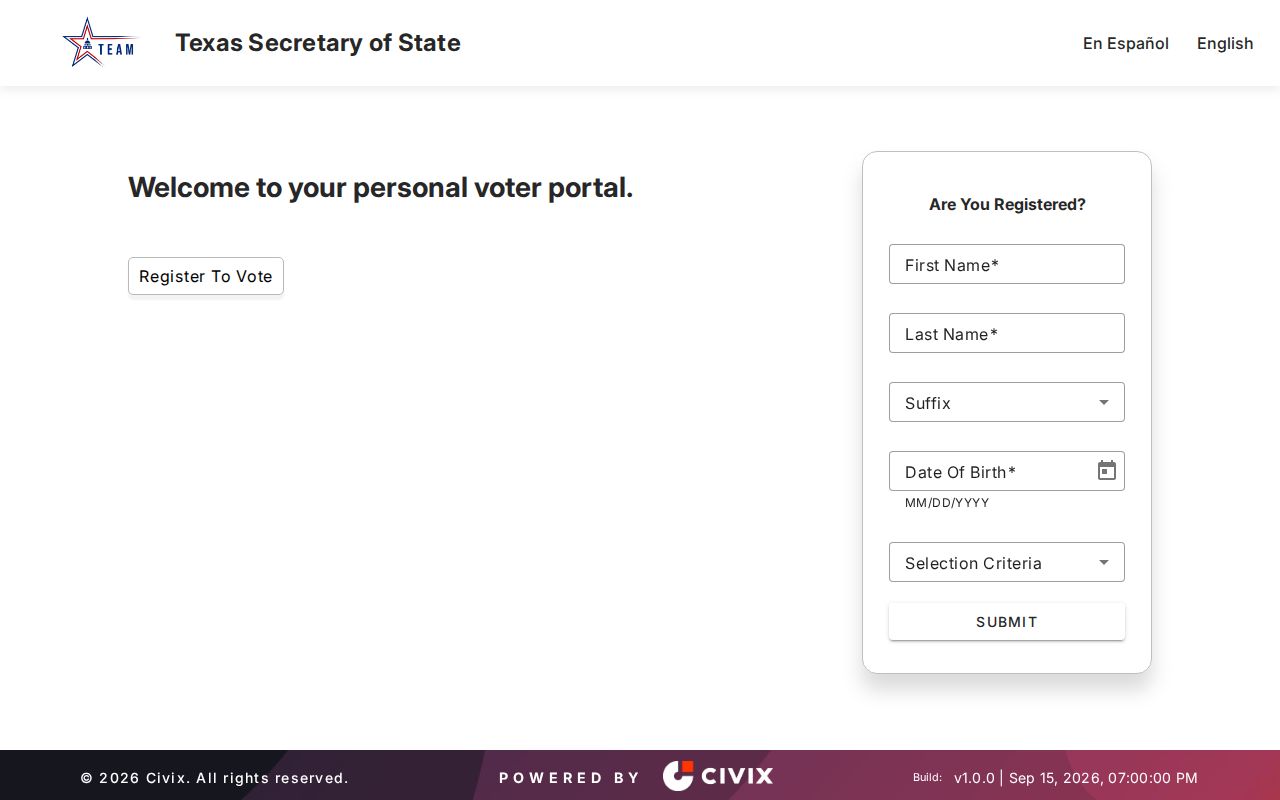
VoteTexas lets a voter check registration by VUID, Texas driver's-license number supplied during registration, or first and last name. It is for an individual status check, not a browseable household directory. A name search can return more than one person, so county and other known facts matter. Registration is administered by the county even though Texas maintains a statewide computerized list.
The VoteTexas lookup uses one of those identifier paths and returns status and election details. The screen shown here is the public check a voter can use to confirm registration. It does not turn an address into a list of everyone nearby.
For broader research, Texas Election Code Chapter 18 provides a separate voter-list request route through the Secretary of State or county registrar. The request form asks who is requesting, what list and time period are wanted, the delivery format, and a use certification. The state describes a zipped fixed-width file and warns against commercial advertising or promotion. A list is not a complete roster of residents, and protected addresses and confidential identifiers remain restricted.
| Lookup field | Search path | Limit |
|---|---|---|
| VUID | Number on a registration certificate | Voter's own status route |
| Texas driver's-license number | Use only if supplied during registration | Not a public motor-vehicle search |
| First and last name | Name mode with county context | Possible same-name results |
Texas Owner Records and Address Types
A Texas appraisal card separates the situs address from the mailing address. Situs is the physical parcel location; mailing is where a tax notice goes. A trust, company, accountant, relative, or out-of-county destination may receive the bill. A homestead exemption can support an owner-occupancy inference, but it does not name every person who lives there.
The map point, parcel polygon, deed's legal description, and postal label are four different ways to describe a place. TxGIO gathers local address points maintained for 9-1-1 and planning. It does not set title or edit county ownership. Use an address point to orient the search, then follow the parcel ID to its appraisal card and county deed index. The Texas street directory lays out that address-to-parcel chain street by street.
Keep both addresses. Write down the situs and mailing address separately. Neither one alone identifies everyone connected with a parcel.
- Situs address
- The physical place the appraisal district values.
- Mailing address
- The delivery point for a tax notice.
- Parcel ID
- The district's account key used to join map and tax records.
- Legal description
- The lot, block, survey, or tract wording used by deeds and plats.
Following a Texas Deed Record
Texas has no statewide grantor-grantee index. A deed search belongs to the county clerk where the land or instrument is recorded. Start with the current appraisal card, copy its owner name and legal description, then open that county's official public records search. If the portal has no address field, search the owner by name and narrow the results with document type, date, and land description.
Read the image or certified copy after an index result. Record both parties, the instrument number, recording date, book and page when shown, document type, and legal description. Then search the seller as an earlier buyer. Repeat backward while checking for releases, liens, plats, probate transfers, correction deeds, or court orders. A recorded deed connects a person to a parcel at a point in time; it does not prove that person occupied it.
Online indexes stop at different years, and no statewide list publishes every county's cutoff. When a web search runs out, ask the clerk about its public terminal, deed books, image access, and copy charges. TSLAC, the Texas Digital Archive, FamilySearch, and local microfilm can extend the trail, but certified copies come from the county custodian.
Texas Court Search and Clerk Files
re:SearchTX is the statewide public search layer for integrated e-filed civil, family, and probate records. It requires an eFileTexas account or registration, then offers Cases, Filings, Text in Documents, and Hearings modes with filters for county, court, party, filing type, and date. A case detail or filing detail may expose available documents. Coverage depends on county integration, security rules, and case type.
The Texas Judicial Council's 2024 report described roughly 150 million documents and case dates generally back to 2016, while excluding most criminal case records. Integration continued after that report, so an empty search is not proof that a file does not exist. Check the district, county, municipal, justice, or probate clerk that holds the record. Appellate records use a separate court search; federal records are held in a separate federal system.
Texas court records can name a party or attorney and show a case number, court, county, filing date, and result status. Restricted, sealed, or confidential documents may not appear, and a docket event alone does not establish what happened. Ask the clerk for a copy or certified record by case number, using court-record access rules rather than assuming the Public Information Act applies.
Texas Vital Indexes Before Copies
Texas DSHS Vital Statistics holds statewide birth, death, marriage, and divorce indexes, but the certified source depends on the record. Under Government Code §552.115, birth records become public on the 75th anniversary and death records on the 25th. Inside those periods, a requester must qualify or show a direct and tangible interest. The index is for discovery; it is not an image of a certificate.
Digital birth indexes cover 1925 forward and death indexes cover 1965 forward. Older microfiche begins in 1903. A digital index year costs $10; the DSHS index page lists names with event date, county, and sex. Marriage index material starts in 1966 and divorce in 1968, but clerk submissions are not comprehensive. Before those years or when a name is missing, contact the county clerk or district clerk where the event occurred.
Certified marriage licenses come from the issuing county clerk; certified divorce decrees come from the district clerk. Local registrars may issue eligible birth or death copies. DSHS forms set identity and relationship requirements, and application fees are not refunded just because no match is found. Check the current form and eligibility route before sending sensitive details.
Older Texas Directories and Resident Rolls
Texas city directories can place a person at an address between census years. TSLAC lists print and microform holdings, but the available years differ by town; its guide does not claim one continuous statewide run. The TSLAC directory guide links to digitized Texas volumes, including the Portal to Texas History, and to other collections. UT Austin's Dolph Briscoe Center holds telephone and city directories for many Texas communities from roughly the late 1800s onward, with gaps.
Read the title page, publisher, year, and abbreviation key before using an entry. A volume may list a spouse, occupation, phone, address, and owner or renter mark, but fields vary. For exact shelf routes, online collections, and a household-by-household method, see the Texas city directory collections page.
Texas County Microfilm and Archives
Before many county books appeared online, TSLAC and the Genealogical Society of Utah filmed local deed, probate, voter, tax, court, and vital records. TSLAC now routes material through 23 Regional Historical Resource Depositories, its Austin and Liberty collections, interlibrary loan, the Texas Digital Archive, and FamilySearch. That preservation network is a Texas records story with a practical use: a missing search result may mean the book is held on film, not that the record never existed.
The TSLAC county-record index identifies county series and access routes. Not every county or record type was filmed, and some pages are faint or restricted to an affiliate library. TSLAC cannot issue certified copies. Use the film to locate a person or instrument, then ask the current county clerk or district clerk for certified proof. Keep the county, series, reel, and date range together in the notes.
Austin and Houston Permit Searches
City permit records can add a date to an address trail, but there is no statewide permit index. Austin's AB+C Public Search is a free model for permit and case lookup without registration. Its documented fields include permit, folder, right-of-way, case, property, project name, type, and date range. A property or project search can return status, related folder, issue and final dates, and plan attachments where available.
Houston's separate portal shows how much local fields vary. Its permit system includes owner or contractor, status, date, street number and name, and ZIP filters. Treat both systems as city examples, not a Texas standard. When older plans or archived cases are missing online, Austin directs readers to a Public Information Request. A permit applicant may be a contractor, so the result is a dated work clue, not proof of who lived at the building.
Texas Business and Unclaimed-Property Leads
ClaimItTexas lets a person search the Comptroller's unclaimed-property database by name and file a claim with proof of ownership. A match can connect a name to an older address or financial account, but it does not prove a current Texas residence. Use the state claim route directly and do not pay a caller who says a fee will release an account.
For a public business role, Texas SOSDirect searches entities, assumed names, registered agents, people, and UCC records. It lists a $1 search fee and account/payment requirements; the state is moving functions into SOS Portal, so check which system is current. A registered office or service address belongs to that public filing and should not be treated as a private home address.
Requesting Texas Records Safely
For an existing non-court record that is not online, send a written request under the Texas Public Information Act, Government Code Chapter 552. The Attorney General's request guidance explains delivery by mail, email, hand delivery, or another method approved by the governmental body; there is no single statewide submission form. Name the record, custodian, date range, address, parcel, or case number. The government must respond promptly and generally within ten business days must release it, set a production date, seek an Attorney General ruling, state that it has no responsive record, or rely on a prior determination.
Do not ask an office to create a new list or investigate a person. Court case records follow clerk and court-access rules, not automatically the PIA. Texas law also protects some addresses and personal fields through the Address Confidentiality Program, voter rules, and public-information exceptions. A public result may be delayed, redacted, or absent for a lawful reason.
A careful Texas residents directory search stays narrow: note what an official record shows, then stop when a protected detail is withheld.